

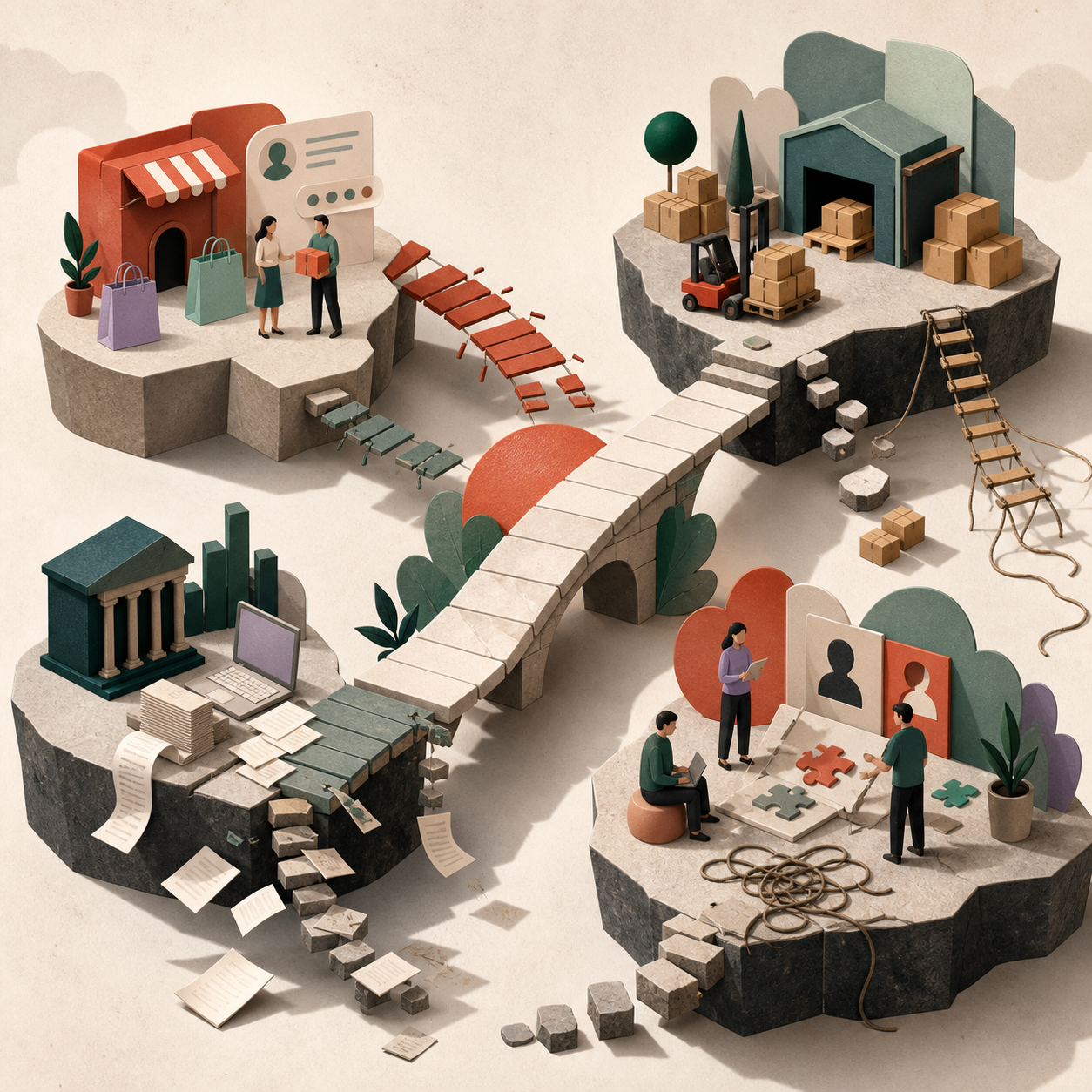
Why Growing Businesses Outgrow Disconnected Systems
Separate tools may solve individual problems, but they also create duplicate work, delayed decisions and an incomplete view of the business. Here is how to recognize the hidden cost—and what a connected operating model changes.
Most growing companies do not set out to build a fragmented technology environment. It happens gradually. A finance tool is introduced first, then a CRM, an inventory application, a project tracker and several spreadsheets created to bridge the gaps.
Each system may work well on its own. The problem appears between them. Customer details are entered more than once, teams disagree about which report is current, approvals move through email, and managers wait for somebody to assemble information before making a decision.
At that point, the company is no longer simply using several applications. It is carrying the operational cost of keeping those applications aligned.
THE HIDDEN COST
Fragmentation creates work that customers never see
The clearest cost of disconnected systems is manual administration. Employees copy information between tools, reconcile totals, correct inconsistent records and confirm status with other departments. Those activities consume time without directly improving the product or customer experience.
Fragmentation also makes routine change more difficult. Adding a branch, warehouse, service line or approval step affects several tools at once. What worked for a smaller organization becomes fragile as transaction volume and organizational complexity increase.
WARNING SIGNS
How to know the operating model has reached its limit
A system landscape does not need to be completely broken to become a constraint. The strongest warning signs are usually accepted as normal daily work:
- Sales cannot confirm stock or delivery dates without contacting operations.
- Finance closes the month by exporting and reconciling several spreadsheets.
- Customer information differs between sales, service and accounting teams.
- Managers depend on individually prepared reports rather than shared live data.
- Approvals are difficult to trace because decisions happen through email or chat.
- A small process change requires updates in several applications and templates.
These symptoms indicate that integration work has become part of normal operations. Employees are effectively acting as the connection layer between systems.
A CONNECTED MODEL
What changes when operations share one foundation
A connected platform does more than place applications under one login. It allows the same business record to move through a controlled lifecycle. A confirmed sale can reserve inventory, generate delivery work, support invoicing and update financial reporting without recreating the transaction at every stage.
Odoo is designed around this shared-record approach. CRM, Sales, Purchase, Inventory, Projects, Manufacturing, Services and Accounting can operate as connected applications. The exact combination should follow the company’s processes; installing more applications is not a substitute for good design.
IMPLEMENTATION ROADMAP
Unify the business in deliberate stages
A successful ERP initiative should reduce operational risk, not introduce unnecessary disruption. The strongest implementations begin with the most valuable connected processes and expand after the foundation is stable.
Understand the real workflow
Map how work moves today, including exceptions, approvals, duplicated entry and informal spreadsheets. Design for the business reality—not only the written procedure.
Build the shared foundation
Define customers, suppliers, products, accounts, analytic structures, roles and permissions before automating dependent processes.
Connect high-value processes
Prioritize flows that cross departments, such as lead-to-cash, procure-to-pay, inventory fulfillment or project-to-invoice.
Improve after real adoption
Measure usage, resolve practical friction and introduce advanced automation only after teams are working reliably in the new model.
MEASURING SUCCESS
Measure operational improvement, not software activity
Logging into a new platform is not the objective. Success should appear in faster work, stronger controls and better decisions. Establish a baseline before implementation, then monitor a small set of practical outcomes.
The right target is not a company with no spreadsheets or no specialized tools. It is a company where every system has a clear purpose, important records have an accountable source, and information moves without unnecessary human repair.
KEY TAKEAWAY
Integration should remove friction from growth
Disconnected tools often remain tolerable until the business grows. Then the hidden work between systems becomes a barrier to speed, service and control. A connected Odoo implementation can replace that friction with a shared operational foundation—but only when it is designed around real processes, introduced in manageable phases and measured by business outcomes.